


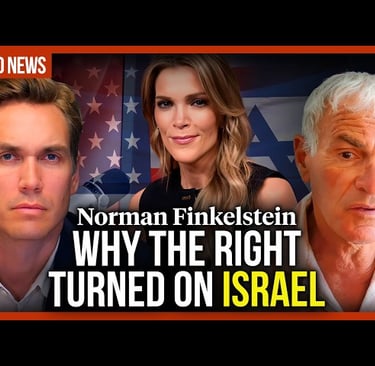
Why Did the Right Turn Its Back on Israel?
For decades, the bond between the American Right and the State of Israel was viewed as an "ironclad" and unshakable partnership. However, recent developments—particularly in the wake of the events of October 2023—reveal a profound and unprecedented fracture in this political alliance. Professor Norman Finkelstein, the renowned political scientist and critical voice, provides a forensic analysis of this shift. He explores how the American Right—ranging from political figures like Donald Trump and J.D. Vance to media titans like Tucker Carlson—has moved away from unquestioning support toward a stance of sharp critique. This article outlines the three primary factors Finkelstein identifies in this historic transformation.
7/15/20263 min read

Why Did the Right Turn Its Back on Israel?
An Analytical Inquiry Based on the Insights of Professor Norman Finkelstein
Introduction
For decades, the bond between the American Right and the State of Israel was viewed as an "ironclad" and unshakable partnership. However, recent developments—particularly in the wake of the events of October 2023—reveal a profound and unprecedented fracture in this political alliance. Professor Norman Finkelstein, the renowned political scientist and critical voice, provides a forensic analysis of this shift. He explores how the American Right—ranging from political figures like Donald Trump and J.D. Vance to media titans like Tucker Carlson—has moved away from unquestioning support toward a stance of sharp critique. This article outlines the three primary factors Finkelstein identifies in this historic transformation.
1. The "America First" Doctrine and the End of Foreign Wars
The first and most obvious factor Finkelstein identifies is the rise of the "America First" platform within the Republican base. Donald Trump rose to power on a promise to end "foreign wars" and avoid endless entanglements. Finkelstein argues that prominent members of Trump’s original coalition now view Israel not as a strategic asset, but as the "vector" by which the United States remains entrenched in Middle Eastern conflicts.
He specifically points to the tensions regarding Iran. According to Finkelstein, the sentiment among certain right-wing figures that Israel is attempting to drag the U.S. into a war with Iran is rooted in a perceived "feeling of betrayal." Unlike the era of Dick Cheney and Donald Rumsfeld—who Finkelstein argues pursued wars based on perceived U.S. national interests rather than being "duped" by Israel—the modern Right is no longer willing to sacrifice the U.S. economy and national image for Tel Aviv’s objectives.
2. The "Retail" Factor and the Power of the Podcast Universe
Finkelstein highlights a tectonic shift in the nature of power within the digital age. He utilizes the term "retail factor" to describe the priorities of the "podcast universe": likes, shares, and views. In the past, criticizing Israel carried heavy professional and social costs. Today, however, the opposite is true.
In Finkelstein’s view, for the first time in living memory, the issue of Palestine at the "grassroots level" does not sink a political ship—it "buoys" it. He observes that it now takes "exactly zero courage" to be a harsh critic of Israel. Conversely, it takes a certain amount of courage to be pro-Israel in the current climate, as figures like Ben Shapiro find themselves "laughed off the web" and suffering significant losses in audience engagement for their support of Israel. This shift in public opinion has compelled right-wing influencers to align with anti-Israel sentiments to maintain their relevance.
3. The Overreach of the "Billionaire Supremacist Class"
One of Finkelstein’s most trenchant critiques involves what he calls the "Jewish supremacist billionaire class." He argues that the pro-Israel lobby "overplayed its hand" in an "outrageous, brazen, and flagrant way."
Finkelstein explains that in the past, this influence was wielded behind closed doors through quiet phone calls to university presidents to suppress dissent. However, after October 7, 2023, this pressure became public and aggressive. By openly using financial leverage to dictate university policy and oust administrators, they effectively ended the illusion of academic freedom on American campuses. Finkelstein characterizes this as an "in-your-face" display of power that triggered a "rational" (rather than irrational) hostility among the public. He posits that when a group uses its wealth so blatantly to suppress the constitutional rights of Americans, the resulting backlash is a predictable reaction to their conduct.
4. The Mask of Compassion and the Exploitation of Stereotypes
Finkelstein maintains a healthy skepticism toward the newfound "outpouring of compassion" for the people of Gaza coming from figures like Tucker Carlson or Megyn Kelly. He notes that the Right is historically not known for supporting national liberation struggles or showing compassion for "poor, brown-skinned Muslims."
He acknowledges that while roughly "70% of what Tucker Carlson says is true" regarding the facts of the conflict, the remaining 30% is deeply problematic. Finkelstein warns that Carlson and others are skillfully packaging these truths within "classical stereotypes." By framing Ben Shapiro as a "worshiper of Mammon" or Miriam Adelson as the "pushy Jew," the Right is tapping into ancient tropes. Finkelstein draws a sobering historical parallel to the 1930s, noting how the far-right in Germany packaged itself as a "Workers' Party" and used "Socialist" labels to co-opt the language of the Left. He suggests that the Right may be using the Israel-Palestine issue as a vector to consolidate power by exploiting underlying prejudices.
Conclusion: A Sobering Assessment
Professor Finkelstein concludes that what we are witnessing is a "settling of accounts." Israel’s actions in Gaza, combined with the heavy-handedness of its billionaire domestic supporters, have created a perfect storm. While the Right’s shift is driven by legitimate anti-war and economic grievances, it also carries the risk of rehabilitating dangerous tropes. Ultimately, the Right has turned its back on Israel because the pro-Israel establishment overreached, making the "ironclad" alliance a liability to the "America First" agenda.