


Revisiting the Norman Finkelstein and Alan Dershowitz Debate (Part 2): In Light of Dershowitz’s Presence in the Epstein Documents
This is a transcript of a high-intensity debate between Professor Norman Finkelstein and Alan Dershowitz, moderated by Piers Morgan. Below is the separation of their arguments and a summary of the conclusions.
2/24/20263 min read
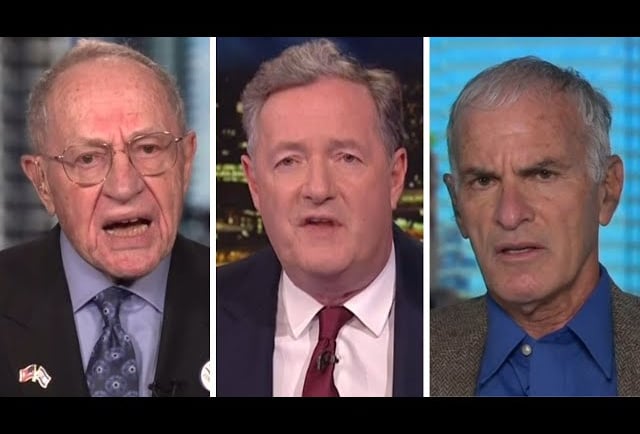
This is a transcript of a high-intensity debate between Professor Norman Finkelstein and Alan Dershowitz, moderated by Piers Morgan. Below is the separation of their arguments and a summary of the conclusions.
Norman Finkelstein’s Arguments
The Root Cause (Zionist "Transfer"): Argues that the conflict began with the "rational fear" of Palestinians that Zionism would result in their territorial dispossession. He cites Benny Morris to state that the idea of "transfer" (expulsion) was "inbuilt and inevitable" in Zionism.
Gaza as a "Concentration Camp": Claims Gaza was turned into a "toxic dump" and a "concentration camp" long before 2023. He cites Israeli figures (sociologist Baruch Kimmerling and former NSC head Giora Eiland) who used the term "concentration camp" to describe Gaza as early as 2003.
Illegality of the Blockade: Asserts that every major international body (World Bank, IMF, UNCTAD) agrees that the primary cause of Gaza's disaster is Israel's illegal blockade, which he defines as "collective punishment" and a war crime.
Settlements as War Crimes: Argues that under Article 49 of the Fourth Geneva Convention and the Rome Statute, Israeli settlements in the West Bank are "protracted war crimes" that have been ongoing for half a century.
The "Nat Turner" Parallel for October 7: Refuses to condemn the perpetrators of October 7. He compares the event to the Nat Turner slave rebellion in U.S. history, arguing that while atrocities occurred, they were the inevitable result of treating people like animals in a "concentration camp" for 20 years.
Statute of Limitations: Challenges Dershowitz’s claim that Palestinians should "move on" after 75 years, noting that if 75 years is a limit, then the 2,000-year-old biblical claim to the land used by Zionists should be even more invalid.
Alan Dershowitz’s Arguments
Arab Rejectionism: Argues that the conflict is the result of Arab leadership rejecting every peace and partition plan since 1937 (Peel Commission). He calls the Nakba a "self-imposed wound" caused by the Arab states launching a "genocidal war" against the new Jewish state.
Population Exchange: Claims there was a legitimate population exchange; 800,000 Jews were expelled from Arab lands and absorbed into Israel, whereas Arab countries intentionally kept Palestinians in refugee camps to maintain a "festering wound."
Critique of UNRWA: Labels UNRWA a "horrible organization" designed to keep Palestinians as permanent refugees rather than integrating them into society.
Legality of the Blockade: Contends that the blockade is 100% legal under international law as a security measure to prevent rockets and tunnels. He blames Hamas for Gaza’s suffering, accusing them of stealing aid to build "350 miles of tunnels" instead of hospitals.
Dismissal of International Courts: Rejects the authority of the International Court of Justice (ICJ), calling it an "illegitimate" and political body whose judges are appointed by hostile regimes.
Moral Condemnation of Oct 7: Calls Finkelstein’s refusal to condemn the massacre "despicable." He argues that no history justifies beheading babies or mass rape, comparing Finkelstein's logic to justifying the Nazis because Germans suffered after World War I.
Piers Morgan’s Interventions
Historical Context: Pushes for a debate on whether the conflict conditions over the last century frame the current war.
Indefensibility of Settlements: States that the continued expansion of settlements in the West Bank is "pretty much indefensible" and makes it hard to sympathize with Israel's position.
Biden’s "Indiscriminate" Comment: Asks Dershowitz if the war has reached a point where even the U.S. might pull support due to "indiscriminate bombing."
Summary of Results (The Final Consensus)
The debate ended in a complete deadlock with zero common ground on the substance of the conflict, summarized by these three points:
1. Legal Disagreement: Finkelstein views international law (UN/ICJ/Geneva Conventions) as the ultimate arbiter, declaring Israel's actions as war crimes. Dershowitz dismisses these international bodies as biased "science fiction" and maintains that Israel’s security measures are entirely lawful.
2. Moral Disagreement: Finkelstein views October 7 through the lens of a "slave revolt" where the ultimate responsibility lies with the "jailer" (Israel). Dershowitz views it as an act of pure evil that must be unequivocally condemned, regardless of historical context.
3. Historical Narrative: Finkelstein frames the history as 75 years of systematic dispossession and "transfer." Dershowitz frames it as 75 years of Arab aggression and rejection of a two-state solution.
Final Result: The only point of agreement reached between the two professors at the very end was that Piers Morgan was a fair moderator.