


Revisiting the Norman Finkelstein and Alan Dershowitz Debate (Part 1): In Light of Dershowitz’s Presence in the Epstein Documents
This is a transcript of the debate between Alan Dershowitz and Norman Finkelstein, moderated by Piers Morgan. Below, the arguments and statements have been separated by speaker, followed by a summary of the debate’s conclusions.
2/21/20263 min read
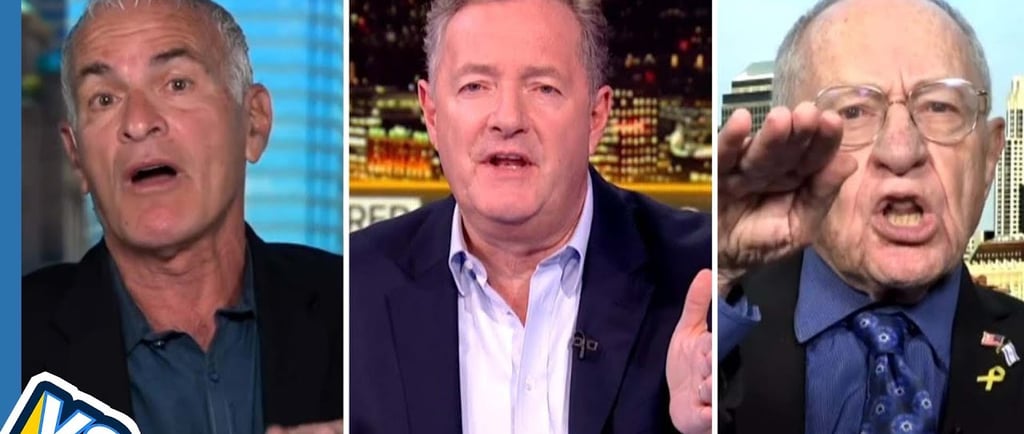
This is a transcript of the debate between Alan Dershowitz and Norman Finkelstein, moderated by Piers Morgan. Below, the arguments and statements have been separated by speaker, followed by a summary of the debate’s conclusions.
Alan Dershowitz’s Arguments
Hamas Strategy: Accuses Hamas of using the "CNN strategy" or "dead baby strategy." He claims Hamas provokes Israel and then hides behind civilians and tunnels, knowing that civilian casualties will lead to international condemnation of Israel.
Responsibility for Deaths: Asserts that all civilian deaths in Gaza are the fault of Hamas for starting the war and using human shields. He argues that if Hamas surrendered and laid down its arms, no civilians would be killed.
Personal Attack on Finkelstein: Criticizes Finkelstein for his initial comments on October 7th, where Finkelstein stated that the events "warmed every fiber of his soul," accusing him of celebrating the murder of innocent people.
International Bias: Claims that organizations like the UN, Human Rights Watch, and Doctors Without Borders are not objective and are historically biased against Israel.
Intent vs. Byproduct: Argues there is a moral and legal difference between the "deliberate" targeting of civilians (like the Nazis) and the "inevitable" death of civilians during military actions against legitimate targets (comparing Israel’s actions to the U.S. in Hiroshima).
Definition of Amalek: Claims that when Netanyahu refers to "Amalek," he is referring specifically to Hamas (whom he equates to Nazis), not the Palestinian people.
The Future of Gaza: Hopes for a "Marshall Plan" where the U.S. and Europe rebuild Gaza after Hamas is destroyed, leading to a democratically elected Palestinian government and an eventual two-state solution.
The Blockade: Argues the blockade is a "good thing" designed to prevent Hamas from obtaining rockets and building tunnels.
Norman Finkelstein’s Arguments
Genocidal Intent: Argues that Israel’s war has been genocidal from "Day One." He quotes Israeli Defense Minister Yoav Gallant’s order to deny Gaza food, water, and fuel as evidence of a recipe for genocide against a whole population.
Legal Perspective: Quotes Israeli legal expert Yoram Dinstein, stating that under international law, there is no substantive difference between "deliberate" and "indiscriminate" targeting of civilians.
Infrastructure of Death: Quotes former NSC head Giora Eiland, who stated that Israel needs to create a humanitarian crisis and make Gaza a place where "no human being can exist."
Biblical Rhetoric: Argues that Netanyahu’s "Amalek" reference is a coded call for the destruction of every man, woman, and child, as understood in the context of the Bible in which Israeli society is schooled.
Israeli Public Opinion: Points to polls showing that 60% of Jewish Israelis believe the military is using "insufficient force" in Gaza and should escalate further.
International Consensus: Notes that for decades, the entire world (via UN resolutions) has supported a two-state settlement on the 1967 borders, while the U.S. and Israel have been the sole consistent opponents.
Moral Double Standard: Questions why Hamas is disqualified from peace talks due to killing 1,200 people, while Israel is not disqualified after killing over 15,000 people (including 7,000 children) and engaging in what he calls a war of genocide.
The Path Forward: Demands an immediate end to the "inhuman blockade," the prosecution of war crimes on both sides, and a settlement based on international law.
Piers Morgan’s Interjections/Moderation
The Humanitarian Dilemma: Expresses concern that Israel's strategy of leveling Gaza will not eliminate Hamas or its ideology, but will instead leave 2 million people displaced and radicalized.
Two-State Solution: Questions the feasibility of a two-state solution, noting that the Israeli Ambassador to the UK recently stated that such a solution is "gone."
U.S. Support: Asks if Israel is losing its strongest ally, noting that President Biden characterized Israel's bombing as "indiscriminate."
Summary of Results
The debate highlights a fundamental divide in the interpretation of international law and moral responsibility:
1. On Morality: Dershowitz views the conflict through the lens of intent, arguing that Israel’s goal is to kill terrorists and that civilian deaths are an accidental byproduct forced by Hamas. Finkelstein views the conflict through the lens of results and rhetoric, arguing that the total siege and high death toll prove a systematic intent to destroy the Palestinian people in Gaza.
2. On Legalities: Dershowitz maintains that Israel is fighting a "discriminate" war and sacrificing its own soldiers to avoid civilian deaths. Finkelstein maintains that the "indiscriminate" nature of the bombing and the blockade are war crimes and crimes against humanity.
3. On the Future: Dershowitz remains optimistic that a post-Hamas Gaza can be rebuilt under a Marshall-style plan. Finkelstein is deeply pessimistic, seeing the current destruction as a "Final Solution" to the Gaza question, insisting that only international prosecution and a return to 1967 borders can bring justice.
Conclusion: The two guests reached no middle ground. The discussion ended with Piers Morgan acknowledging the horrific plight of the Palestinians while maintaining that nothing justified the October 7th attacks.